
Improving The Partner Journey By Building A User Centered Mindset
HubSpot partners are small and medium businesses (SMB) that manage multiple HubSpot accounts and handle onboarding, configuration, and customer management. On the partner facing platform, they often rely on support for routine tasks like setting up accounts, granting access, or understanding payments. In this project, I show how I introduced a user focused approach that improved the partner experience, reduced support dependency, and allowed partners to manage more clients, contributing to overall account growth at Hubspot.
Disclaimer: The perspectives and descriptions in this case study represent my own experience and do not necessarily reflect the official views of the company.

HubSpot, 2024
HubSpot is a CRM platform that provides marketing, sales, and customer success tools used by companies of all sizes to manage and grow their customer relationships.

Product Design Mangager
I managed a team of four designers, including one design lead and three senior designers, and worked closely with product and tech leads as well as director level stakeholders.

Partner Ecosystem
A platform designed for SMB B2B partners who manage their clients’ HubSpot accounts and handle onboarding, configuration, and ongoing operations.
The Crux
Treating Partners As A Single User Created A Fragmented Experience
experience. However, the map treated “partner” as a single, uniform user. I challenged this assumption, noting that each partner is a business composed of multiple roles and responsibilities. The people interacting with our platform were sales reps, account managers, and marketers, and each of them had distinct goals and behaviors.

Proposed Solution
Introducing User Archetypes To Guide A More Focused Journey Design
I proposed breaking the generic “partner” into clear user archetypes based on the tasks they needed to complete, such as managing finances, handling technical setup, or acquiring new customers. Each archetype would then receive its own end to end journey instead of sharing one combined flow. This structure was intended to give us a more accurate view of how each user works and to guide the design of experiences that better match their specific responsibilities.
Building Archetype Assumptions From What We Already Know
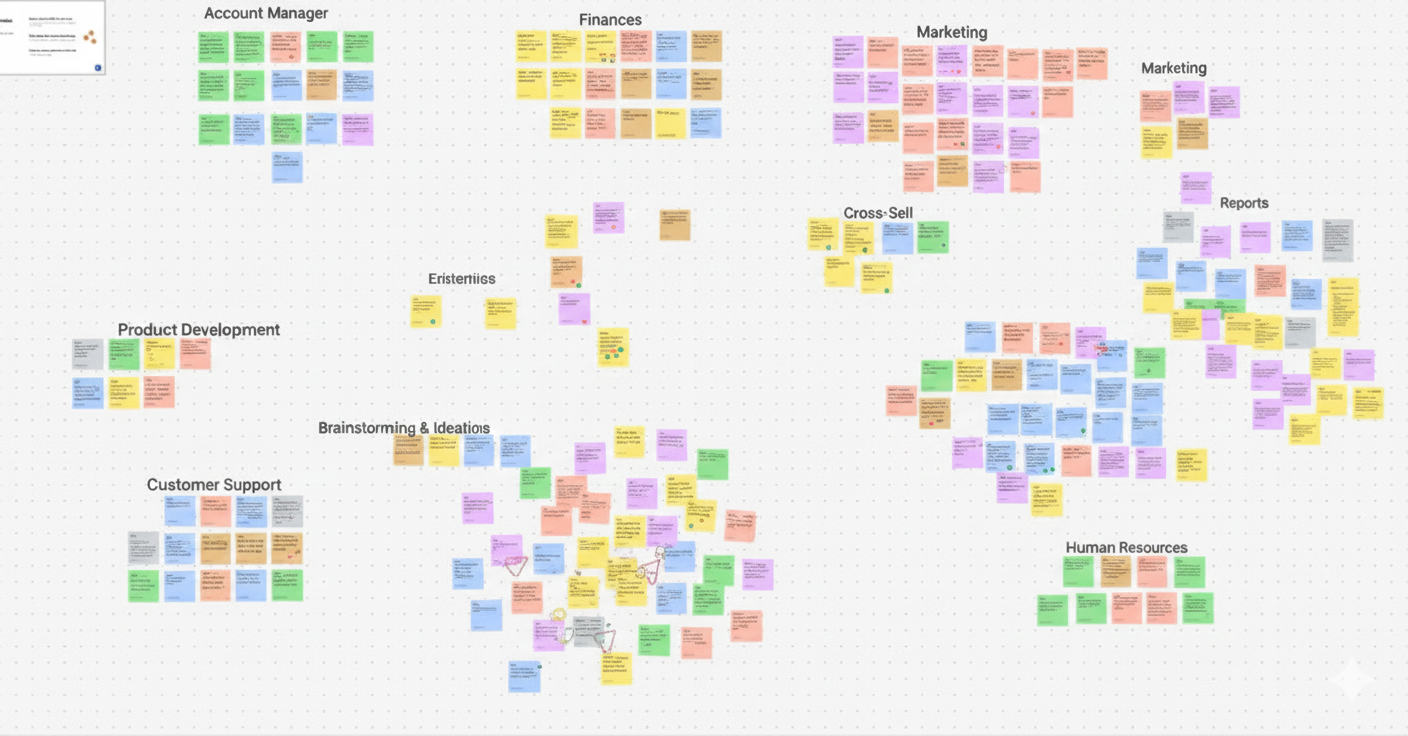
Two Mixed Design And Product Groups
I introduced an archetype workshop to surface user roles in a collaborative way. The group split into two teams and stepped into the perspective of an SMB partner, building a hypothetical business, defining its roles, and assigning the jobs to be done for each one. After sharing their proposals, we compared outputs, aligned on common patterns, and discussed differences until we agreed on six initial user archetypes. We then outlined a full journey for each archetype, giving the team a clearer view of task ownership and highlighting where additional validation would be needed.

Leveraging Existing Research with AI
I instructed the team to draw from the extensive research already available by reviewing documented pain points and workflows and collecting the core jobs to be done behind them. We used Dovetail to centralize all previous user research and apply consistent tagging across studies, which allowed us to classify insights by archetype. This surfaced clearer patterns, sharper distinctions, and gaps that had not been visible in the combined research.

Building A Team of Leaders
I created a project timeline and divided the work into subprojects, assigning a designer to lead each one and mentoring them with ongoing feedback. This helped build confidence and accountability as they took ownership of their tracks. I also encouraged the designers to promote the archetypes within their product teams so the conversation could shift from a generic partner view to specific users with distinct needs and tasks.
A Look At Key Partner Archetypes
I encouraged the designers to promote the archetypes within their product teams so the conversation could shift from a generic partner view to specific users with distinct needs and tasks. Here are some examples of the archetypes we used.

The Value Driver
“Keeps client relationships healthy and drives ongoing value”

The Implementer
Sets up, maintains, and fixes HubSpot configurations for clients

The Deal Closer
Handles negotiations and brings new clients across the finish line
Mapping Jobs To Be Done To Each Archetype
Once the archetypes were defined, I guided the team in mapping the core jobs to be done across the partner workflow and assigning each job to the archetype responsible for completing it. This work drew from both existing research and interviews with people whose real roles aligned with each archetype. I mentored the designer leading the effort, providing direction and feedback to ensure the jobs reflected the needs of specific users rather than a generic partner.
The Value Driver
Maintain ongoing client relationships
Checks HubSpot account activity, responds to client questions, and ensures they understand how to use key features. Uses communication tools and activity logs to stay ahead of client needs.
The Implementer
Troubleshoot and resolve setup issues
Fixes configuration errors, permission gaps, and broken workflows. Uses HubSpot diagnostics and settings to resolve issues before escalating.
The Deal Closer
Monitor account performance and client health
Tracks client activity, deals, and lifecycle metrics using HubSpot dashboards. Identifies drops in engagement or signs of risk.

Partner Journey Example
Improving The Onboarding Experience With Archetypes
Several onboarding steps required technical knowledge that only a subset of users had, yet they were shown to everyone. This added unnecessary complexity and overwhelmed partners with information that did not apply to their role. Once we redefined the user model and assigned each task to a specific archetype, we could see which steps were missing for some users and which were redundant for others. Adjusting the flows accordingly made onboarding smoother and far more relevant.
Results and Impact
Strengthening The Partner Experience And Team Performance

Improved Partner Satisfaction
Measured through the Partner Satisfaction Score, a compound metric that continuously updated based on positive and negative expressions within the platform such as likes and survey responses.
Reduced Support Dependency
Tracked through the number of support tickets, the time account managers spent on calls, and the ratio of partners each account manager could effectively support.
Increased Team Engagement
Monitored through the themes shared in retros, with a focus on the volume of positive feedback and signals of increased ownership and confidence.

Key Takeaway
Making Archetype Discovery Collaborative Brings Teams to Breakthrough Moments
This project reminded me how powerful it is to slow down and question long held assumptions. Once I shifted the conversation from features to the people behind them, the team became more confident, more curious, and more connected. It taught me that clarity is not only a design outcome, it is something you cultivate with your team, and when you do, the work moves forward with much more purpose.
Case Study
Improving The Partner Journey By Building A User Centered Mindset
HubSpot partners are small and medium businesses (SMB) that manage multiple HubSpot accounts and handle onboarding, configuration, and customer management. On the partner facing platform, they often rely on support for routine tasks like setting up accounts, granting access, or understanding payments. In this project, I show how I introduced a user focused approach that improved the partner experience, reduced support dependency, and allowed partners to manage more clients, contributing to overall account growth at Hubspot.
Disclaimer: The perspectives and descriptions in this case study represent my own experience and do not necessarily reflect the official views of the company.
HubSpot, 2024
HubSpot is a CRM platform that provides marketing, sales, and customer success tools used by companies of all sizes to manage and grow their customer relationships.
Product Design Mangager
I managed a team of four designers, including one design lead and three senior designers, and worked closely with product and tech leads as well as director level stakeholders.
Partner Ecosystem
A platform designed for SMB B2B partners who manage their clients’ HubSpot accounts and handle onboarding, configuration, and ongoing operations.
The Crux
Treating Partners As A Single User Created A Fragmented Experience
experience. However, the map treated “partner” as a single, uniform user. I challenged this assumption, noting that each partner is a business composed of multiple roles and responsibilities. The people interacting with our platform were sales reps, account managers, and marketers, and each of them had distinct goals and behaviors.
Proposed Solution
Introducing User Archetypes To Guide A More Focused Journey Design
I proposed breaking the generic “partner” into clear user archetypes based on the tasks they needed to complete, such as managing finances, handling technical setup, or acquiring new customers. Each archetype would then receive its own end to end journey instead of sharing one combined flow. This structure was intended to give us a more accurate view of how each user works and to guide the design of experiences that better match their specific responsibilities.
Building Archetype Assumptions From What We Already Know
Two Mixed Design And Product Groups
I introduced an archetype workshop to surface user roles in a collaborative way. The group split into two teams and stepped into the perspective of an SMB partner, building a hypothetical business, defining its roles, and assigning the jobs to be done for each one. After sharing their proposals, we compared outputs, aligned on common patterns, and discussed differences until we agreed on six initial user archetypes. We then outlined a full journey for each archetype, giving the team a clearer view of task ownership and highlighting where additional validation would be needed.
Leveraging Existing Research with AI
I instructed the team to draw from the extensive research already available by reviewing documented pain points and workflows and collecting the core jobs to be done behind them. We used Dovetail to centralize all previous user research and apply consistent tagging across studies, which allowed us to classify insights by archetype. This surfaced clearer patterns, sharper distinctions, and gaps that had not been visible in the combined research.
Building A Team of Leaders
I created a project timeline and divided the work into subprojects, assigning a designer to lead each one and mentoring them with ongoing feedback. This helped build confidence and accountability as they took ownership of their tracks.
A Look At Key Partner Archetypes
I encouraged the designers to promote the archetypes within their product teams so the conversation could shift from a generic partner view to specific users with distinct needs and tasks. Here are some examples of the archetypes we used.
The Value Driver
“Keeps client relationships healthy and drives ongoing value”
The Implementer
Sets up, maintains, and fixes HubSpot configurations for clients
The Deal Closer
Handles negotiations and brings new clients across the finish line
Mapping Jobs To Be Done To Each Archetype
Once the archetypes were defined, I guided the team in mapping the core jobs to be done across the partner workflow and assigning each job to the archetype responsible for completing it. This work drew from both existing research and interviews with people whose real roles aligned with each archetype. Based on this mapping, we then created more focused user journeys that reflected the needs and responsibilities of each archetype.
The Value Driver
Maintain ongoing client relationships
Checks HubSpot account activity, responds to client questions, and ensures they understand how to use key features. Uses communication tools and activity logs to stay ahead of client needs.
The Implementer
Troubleshoot and resolve setup issues
Fixes configuration errors, permission gaps, and broken workflows. Uses HubSpot diagnostics and settings to resolve issues before escalating.
The Deal Closer
Monitor account performance and client health
Tracks client activity, deals, and lifecycle metrics using HubSpot dashboards. Identifies drops in engagement or signs of risk.
Partner Journey Example
Improving The Onboarding Experience With Archetypes
Several onboarding steps required technical knowledge that only a subset of users had, yet they were shown to everyone. This added unnecessary complexity and overwhelmed partners with information that did not apply to their role. Once we redefined the user model and assigned each task to a specific archetype, we could see which steps were missing for some users and which were redundant for others. Adjusting the flows accordingly made onboarding smoother and far more relevant.
Results and Impact
Strengthening The Partner Experience And Team Performance
Improved Partner Satisfaction
Measured through the Partner Satisfaction Score, a compound metric that continuously updated based on positive and negative expressions within the platform such as likes and survey responses.
Reduced Support Dependency
Tracked through the number of support tickets, the time account managers spent on calls, and the ratio of partners each account manager could effectively support.
Increased Team Engagement
Monitored through the themes shared in retros, with a focus on the volume of positive feedback and signals of increased ownership and confidence.
Key Takeaway
Making Archetype Discovery Collaborative Brings Teams to Breakthrough Moments
This project reminded me how powerful it is to slow down and question long held assumptions. Once I shifted the conversation from features to the people behind them, the team became more confident, more curious, and more connected. It taught me that clarity is not only a design outcome, it is something you cultivate with your team, and when you do, the work moves forward with much more purpose.
Case Study
Improving The Partner Journey By Building A User Centered Mindset
HubSpot partners are small and medium businesses (SMB) that manage multiple HubSpot accounts and handle onboarding, configuration, and customer management. On the partner facing platform, they often rely on support for routine tasks like setting up accounts, granting access, or understanding payments. In this project, I show how I introduced a user focused approach that improved the partner experience, reduced support dependency, and allowed partners to manage more clients, contributing to overall account growth at Hubspot.
Disclaimer: The perspectives and descriptions in this case study represent my own experience and do not necessarily reflect the official views of the company.
HubSpot, 2024
HubSpot is a CRM platform that provides marketing, sales, and customer success tools used by companies of all sizes to manage and grow their customer relationships.

Product Design Manager
I managed a team of four designers, including one design lead and three senior designers, and worked closely with product and tech leads as well as director level stakeholders.
Partner Ecosystem
A platform designed for SMB B2B partners who manage their clients’ HubSpot accounts and handle onboarding, configuration, and ongoing operations.
The Crux
Treating Partners As A Single User Created A Fragmented Experience
When I joined, the team had a detailed journey map which treated “partner” as a single user. However, partner businesses involve multiple roles, such as sales reps, account managers, and marketers, each with different responsibilities. Because the platform did not reflect these roles, the experience became fragmented. Completing a single journey often required several stakeholders, and when those roles did not exist, partners turned to HubSpot for help. This created a pattern where support teams were completing routine tasks for partners instead of enabling them to manage their accounts independently.
Proposed Solution
Introducing User Archetypes To Guide A More Focused Journey Design
I proposed breaking the generic “partner” into clear user archetypes based on the tasks they needed to complete, such as managing finances, handling technical setup, or acquiring new customers. Each archetype would then receive its own end to end journey instead of sharing one combined flow. This structure was intended to give us a more accurate view of how each user works and to guide the design of experiences that better match their specific responsibilities.
Building Archetype Assumptions From What We Already Know
Two Mixed Design And Product Groups
I introduced an archetype workshop to surface user roles in a collaborative way. The group split into two teams and stepped into the perspective of an SMB partner, building a hypothetical business, defining its roles, and assigning the jobs to be done for each one. After sharing their proposals, we compared outputs, aligned on common patterns, and discussed differences until we agreed on six initial user archetypes.
Leveraging Existing Research with AI
I instructed the team to draw from the extensive research already available by reviewing documented pain points and workflows and collecting the core jobs to be done behind them. We used Dovetail to centralize all previous user research and apply consistent tagging across studies, which allowed us to classify insights by archetype. This surfaced clearer patterns, sharper distinctions, and gaps that had not been visible in the combined research.
Building A Team of Leaders
I created a project timeline and divided the work into subprojects, assigning a designer to lead each one and mentoring them with ongoing feedback. This helped build confidence and accountability as they took ownership of their tracks. I also encouraged the designers to promote the archetypes within their product teams so the conversation could shift from a generic partner view to specific users with distinct needs and tasks.
A Look At Key Partner Archetypes
I encouraged the designers to promote the archetypes within their product teams so the conversation could shift from a generic partner view to specific users with distinct needs and tasks. Here are some examples of the archetypes we used.
The Value Driver
Keeps client relationships healthy and drives ongoing value
The Implementer
Sets up, maintains, and fixes HubSpot configurations for clients
The Deal Closer
Handles negotiations and brings new clients across the finish line
Mapping Jobs To Be Done To Each Archetype
Once the archetypes were defined, I guided the team in mapping the core jobs to be done across the partner workflow and assigning each job to the archetype responsible for completing it. This work drew from both existing research and interviews with people whose real roles aligned with each archetype. I mentored the designer leading the effort, providing direction and feedback to ensure the jobs reflected the needs of specific users rather than a generic partner.
The Value Driver
Maintain ongoing client relationships
Checks HubSpot account activity, responds to client questions, and ensures they understand how to use key features. Uses communication tools and activity logs to stay ahead of client needs.
The Implementer
Troubleshoot and resolve setup issues
Fixes configuration errors, permission gaps, and broken workflows. Uses HubSpot diagnostics and settings to resolve issues before escalating.
The Deal Closer
Monitor account performance and client health
Tracks client activity, deals, and lifecycle metrics using HubSpot dashboards. Identifies drops in engagement or signs of risk.
The Value Driver
Identify opportunities for upsell or service expansion
Looks at product usage across Hubs to spot gaps or growth opportunities. Uses reporting insights to suggest relevant upgrades that align with client goals.
The Implementer
Configure and customize HubSpot accounts
Sets up pipelines, workflows, permissions, and integrations based on the client’s needs. Ensures each account is structured correctly so clients can operate smoothly.
The Deal Closer
Produce insights that guide next steps
Builds reports that highlight trends and opportunities. Turns data into clear recommendations for clients and internal teams.
Partner Journey Example
Improving The Onboarding Experience With Archetypes
Several onboarding steps required technical knowledge that only a subset of users had, yet they were shown to everyone. This added unnecessary complexity and overwhelmed partners with information that did not apply to their role. Once we redefined the user model and assigned each task to a specific archetype, we could see which steps were missing for some users and which were redundant for others. Adjusting the flows accordingly made onboarding smoother and far more relevant.
Results and Impact
Strengthening The Partner Experience And Team Performance
Improved Partner Satisfaction
Measured through the Partner Satisfaction Score, a compound metric that continuously updated based on positive and negative expressions within the platform such as likes and survey responses.
Reduced Support Dependency
Tracked through the number of support tickets, the time account managers spent on calls, and the ratio of partners each account manager could effectively support.
Increased Team Engagement
Monitored through the themes shared in retros, with a focus on the volume of positive feedback and signals of increased ownership and confidence.
Key Takeaway
Making Archetype Discovery Collaborative Brings Teams to Breakthrough Moments
This project reminded me how powerful it is to slow down and question long held assumptions. Once I shifted the conversation from features to the people behind them, the team became more confident, more curious, and more connected. It taught me that clarity is not only a design outcome, it is something you cultivate with your team, and when you do, the work moves forward with much more purpose.